Case IH Steiger, Quadtrac & Rowtrac DEF Delete: SCR Derate Fixes and ECU Tuning
November 9, 2026
Nebraska Tractor Remote DEF Delete and DPF Delete
November 10, 2026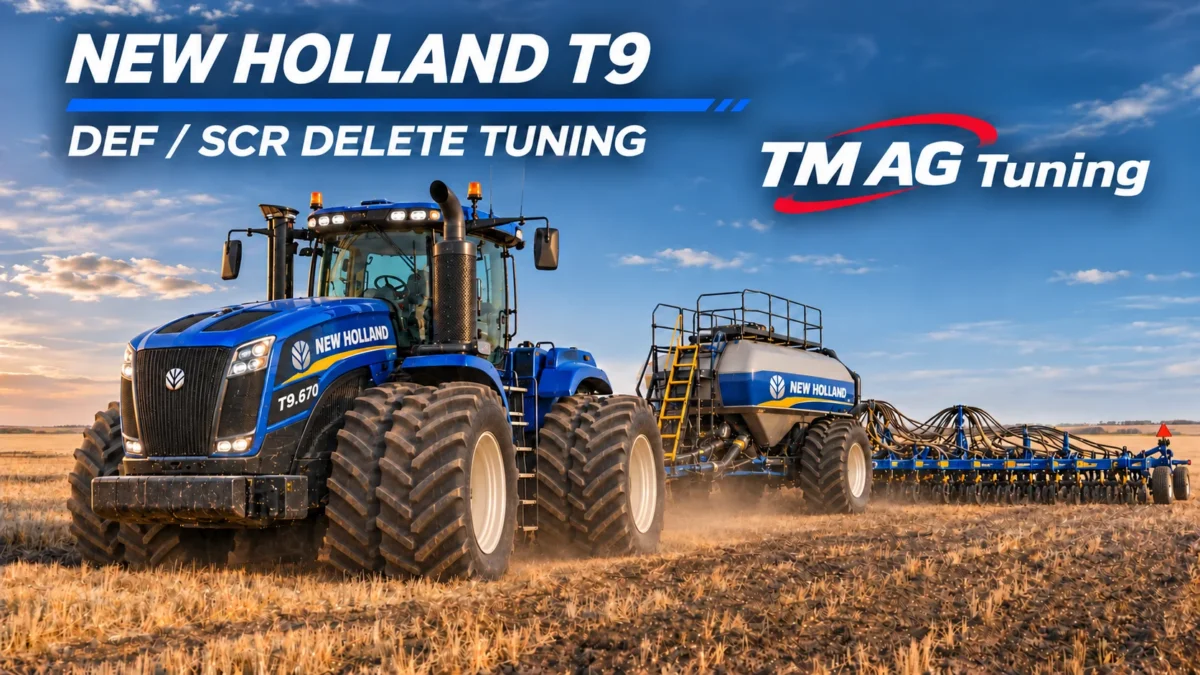
A T8 is often the main row-crop tractor on the farm, and a T9 is usually the biggest 4WD in the yard. Either one is hard to spare when it drops into derate during planting, tillage or harvest. The engine is almost always fine. The problem is the emissions system: a DEF pump, a dosing valve, a NOx sensor, a heater, an SCR efficiency code, or, on some newer Tier 5 tractors, a DPF or regen fault. The tractor still has all its iron, but the software won’t let it pull until the fault clears.
TM AG Tuning is based in Redcliff, Alberta. We do ECU tuning and DEF, DPF and EGR delete calibrations for agricultural, construction and forestry equipment and diesel trucks across the U.S. and Canada. This page covers New Holland T8 and T9 tractors, including Genesis T8 models, Auto Command and Ultra Command transmissions, PLM Intelligence tractors, and T8 and T9 SmartTrax: what the emissions system actually does, why these tractors derate, what changes after a delete, and how to get yours looked at.
Looking for another New Holland machine? Start with our New Holland DEF delete overview.
How T8 and T9 work is done: remotely. We mail a tuner to you, so your ECU never leaves the tractor. We support T8 and T9 tractors from Tier 4A, Tier 4B/Final and Stage V (Tier 5). To get started, select your T8 or T9 on our Make and Model Search page. Support then confirms the exact emissions setup on your tractor.
What’s Actually on a T8 or T9: DEF/SCR on Tier 4, and a DPF on Some Tier 5 Models
Most “delete” pages lump DEF, DPF and EGR together. On a T8 or a T9, that’s often misleading, and it’s worth getting right.
These tractors use FPT Industrial Cursor engines. The T8 line uses the 8.7-litre Cursor 9, from the first Cursor-powered models through the current Genesis T8 series with PLM Intelligence. Most T9 4WD tractors use the 12.9-litre Cursor 13, and we also support Cursor 16-powered T9s. One exception is the earlier T9.435, which used the Cursor 9. To meet Tier 4 emissions rules, New Holland and FPT went with an SCR-focused strategy that New Holland calls ECOBlue HI-eSCR (High Efficiency SCR). New Holland describes this as working without exhaust gas recirculation, and Tier 4A and Tier 4B/Final specifications list no DPF and no EGR, with a diesel oxidation catalyst and SCR with DEF.
So for most North American Tier 4A and Tier 4B/Final T8 and T9 tractors, a “DEF delete” really means an SCR delete. There’s no particulate filter to regenerate and no EGR valve to stick. Older pre-Tier 4 predecessors don’t have DEF at all.
Newer Stage V (Tier 5) T8 and T9 tractors may also have a DPF. FPT calls the Stage V system HI-eSCR2 and describes a filter on the SCR catalyst. We handle both the DEF/SCR side and the DPF on those tractors. Configurations can still differ by year, market and engine, so once you select your machine on our Make and Model Search page, support confirms the exact setup before any work is done.
The T9 is New Holland’s counterpart to the Case IH Steiger. Wheeled T9s and T9 SmartTrax models share the same FPT Cursor engine family, including Cursor 13 and Cursor 16, and the same style of aftertreatment as Steiger, Quadtrac and Rowtrac tractors. If you run both brands, see our Case IH Steiger, Quadtrac and Rowtrac DEF delete page.
DEF and SCR
DEF (Diesel Exhaust Fluid, called AdBlue in Europe) is a urea and deionized water solution kept in its own tank. It never goes into the engine. The tractor sprays it into the exhaust ahead of the Selective Catalytic Reduction (SCR) catalyst, where it helps convert nitrogen oxides (NOx) into nitrogen and water.
Because a T8 or T9 engine is tuned to burn cleanly and efficiently in the cylinder, the SCR system does the heavy lifting on NOx. That puts a lot of dependence on parts that live outside in field weather:
- The DEF tank, level and temperature sensors, and tank heater
- The DEF supply module (pump) and heated lines
- The dosing valve that sprays DEF into the exhaust
- NOx sensors before and after the catalyst
- The DOC, SCR catalyst and cleanup catalyst
- The ECU logic that monitors all of it
A DEF quality or level code is not always bad fluid. Contaminated or diluted DEF can set a code, but so can a failed sensor, a heater fault, or an SCR efficiency problem.
DPF and EGR (and why we still mention them)
A DPF traps soot and has to regenerate; EGR routes cooled exhaust back into the intake to cut NOx. On Tier 4A and Tier 4B/Final T8 and T9 tractors, those parts are typically not there, so a “DPF delete” or regen complaint on a Tier 4 machine is usually an SCR or sensor issue. Newer Stage V (Tier 5) tractors may also have a DPF, as part of the HI-eSCR2 system with a filter. We handle both DEF/SCR and DPF on those models. Select your tractor on our search page and support will confirm what’s actually on yours.
Why T8 and T9 Tractors Go Into DEF, SCR and DPF Derate
These tractors work long days under heavy load, then sit through cold Midwestern and Canadian winters. The aftertreatment system takes that abuse along with the rest of the tractor. These are the faults that usually bring T8 and T9 owners to us:
- DEF supply and pressure faults. A weak or failed supply module, a plugged filter, or a leaking line.
- Dosing valve problems. A sticking or crystallized doser that can’t spray what the ECU asks for.
- DEF heating faults. Failed tank or line heaters, especially early and late in the season.
- DEF quality and level codes. Contaminated or diluted fluid, or a sensor that reads wrong.
- NOx sensor failures. If the ECU can’t confirm the SCR is working, it assumes it isn’t.
- SCR efficiency codes. The catalyst isn’t reducing NOx as much as the software expects, sometimes with no obvious failed part.
- DPF and regen faults on newer Tier 5 tractors. A filter or regen issue can derate a Stage V machine the same way an SCR fault does on a Tier 4 tractor.
- Wiring and connector problems. Chafed harnesses and corroded connectors, especially on a long T8 hood or a big articulated T9.
The frustrating part is the timing. Emissions monitoring can step from a warning light to reduced power, and on many systems to a severe derate if the fault isn’t fixed. On a T8 pulling a planter or a T9 on a big disc, a derate effectively parks the tractor. For general first steps when a machine drops into limp mode, see What to Do When Your Tractor or Skid Steer Is Derated.
What Changes After a T8 or T9 DEF/SCR Delete
For T8 and T9 owners, the reason is almost always uptime. A tractor sitting in the yard waiting for a supply module, NOx sensor or, on a Tier 5 machine, a DPF repair during a tight planting or tillage window costs far more than the part.
When the calibration is done properly, owners typically see these changes:
- No more DEF-related shutdowns. Supply module, doser, heater, NOx sensor and SCR efficiency faults stop being a reason the tractor can’t work.
- No more DEF. No buying, storing or hauling fluid to the field, and no frozen, crystallized or contaminated fluid.
- No more DPF regen derates on Tier 5 tractors that have a filter. We include the DPF side in the calibration on those machines.
- Fewer expensive emissions parts to replace. Dosers, supply modules, NOx sensors and, where fitted, DPF-related parts no longer have to be replaced just to keep the tractor running.
- A way out of repeat derates. Tractors that keep falling back into derate after codes are cleared and parts are swapped are the most common case we see.
- An optional horsepower tune. We offer power tuning on all New Holland machines, on its own or with the delete, and we have done HP tunes on T9s. Gains depend on the model, so support tells you what to expect once they know your tractor.
- A lifetime software warranty. If a dealer reflash overwrites the calibration, or the ECU is replaced, we re-delete it for free.
We don’t publish horsepower figures or fuel-savings percentages, because results depend on the tractor, its software, the load and the conditions. A delete calibration also won’t fix an unrelated fuel, turbo, transmission, hydraulic or electrical problem, which is why support checks your tractor before any work starts.
How Our Remote T8 and T9 Service Works
T8 and T9 work is done remotely. There’s no ECU to pull and nothing to ship to us: we mail you a tuner, and the tractor stays on your farm.
- Select your tractor. Choose your New Holland T8 or T9 on our Make and Model Search page. That creates a ticket with our support team.
- Support replies with what’s needed. We confirm your tractor, including whether it is a Tier 4 SCR-only machine or a Tier 5 tractor with a DPF, and the work you want, including a horsepower tune if you’re interested. You don’t need to gather paperwork, codes or photos before you start. Support will ask for anything it actually needs.
- We mail you a tuner. It arrives with instructions, and support is on your ticket if you have questions.
- Your tractor is calibrated remotely. Our team handles the calibration through the tuner while the tractor sits in your yard.
- You get back to work. If anything isn’t right afterward, reply on your support ticket.
To see how this works on other equipment, read How Remote Tuning Works for Agricultural and Construction Equipment.
Lifetime Software Warranty
Your calibration is covered for life. If a dealer updates the tractor and the reflash overwrites our calibration, or the ECU is replaced, we re-delete it for free. You don’t lose what you paid for because the tractor went in for service. See our warranty and refund policy.
A calibration for one T8 or T9 doesn’t automatically carry over to another. Engine (Cursor 9, Cursor 13 or Cursor 16, including single-stage or two-stage turbo on some T9s), software version and emissions tier vary across the line, so support confirms your exact tractor first.
New Holland T8 and T9 Models We Work On
We support T8 and T9 tractors from Tier 4A, Tier 4B/Final and Stage V (Tier 5), in wheeled and SmartTrax layouts.
New Holland T8 and Genesis T8
The high-horsepower row-crop T8, from the earlier T8 series (T8.275 through T8.390, plus the T8.420) through the Genesis T8 series with PLM Intelligence (T8.320 through T8.435, plus later T8.325, T8.355, T8.385, T8.415 and T8.440). That includes Ultra Command powershift and Auto Command CVT tractors, and T8 SmartTrax, which uses factory rear tracks on T8.410 and T8.435.
T8 models we’ve tuned recently include the T8.275, T8.300, T8.320, T8.350, T8.360, T8.380, T8.390 and T8.410.
New Holland T9 and T9 SmartTrax
The articulated 4WD T9, including earlier models such as the T9.390 and the T9.450 through T9.670, later ranges (T9.435 through T9.700), and the current T9 series with PLM Intelligence (T9.470 through T9.700). That includes Cursor 13 and Cursor 16-powered models, standard-frame and wide-frame tractors, scraper configurations, Auto Command and Ultra Command transmissions, and T9 SmartTrax.
T9 models we’ve tuned recently include the T9.390, T9.435, T9.450, T9.480, T9.505, T9.530, T9.615, T9.645 and T9.655. We have also done horsepower tunes on T9s; gains depend on the model, so support tells you what to expect once they know your tractor.
Run another New Holland or Case IH machine? We tune both remotely, so select it on our search page. For the Case IH twin of the T9, see our Case IH Steiger DEF delete page.
New Holland T8 & T9 DEF Delete: Frequently Asked Questions
Does my T8 or T9 have a DPF or EGR?
Most Tier 4A and Tier 4B/Final T8 and T9 tractors don’t. Those use an SCR-focused ECOBlue HI-eSCR system, so the DEF/SCR side is usually what’s causing the derate. Newer Stage V (Tier 5) tractors may also have a DPF (HI-eSCR2 with a filter). We handle both DEF/SCR and DPF on those models. A DEF code also isn’t always bad fluid. Select your tractor on our search page and support will confirm the setup.
Is the work done remotely, or do I have to ship the ECU?
Remotely. We mail you a tuner, so the ECU stays in the tractor. There’s no bench drop-off and no ECU to pack up.
Which T8 and T9 years do you support?
Tier 4A, Tier 4B/Final and Stage V (Tier 5) T8 and T9 tractors, including earlier T8s such as the T8.275 through T8.390, earlier T9s such as the T9.390, Genesis T8, later T8.325 through T8.440 models, PLM Intelligence models, Cursor 16-powered T9s, and T8 and T9 SmartTrax.
Does this cover T8 SmartTrax and T9 SmartTrax as well as wheeled tractors?
Yes. They share the same engine and emissions families as the wheeled models, so they’re covered the same way. Select your exact tractor on our search page and support will confirm.
Can I get more horsepower too?
Yes. We offer horsepower tuning on all New Holland machines, and we have done HP tunes on T9s. Gains depend on the model, so support confirms what to expect once they know your tractor.
What if a dealer update wipes the tune?
It’s covered by our lifetime software warranty. If a dealer reflash overwrites the calibration or the ECU is replaced, we re-delete it for free.
Why Professional Calibration Matters
A T8 or T9 ECU doesn’t have an “emissions off” switch. On HI-eSCR engines, the ECU manages both the engine and the aftertreatment, so torque limits, fault monitoring and derate logic are tied together in the same software. Unplugging sensors, using emulators or running a poor file can leave warning lights, communication faults, uneven power or new derates. Doing it right means identifying the exact controller and software, and building a calibration that matches the tractor’s hardware and how it’s used.
Get Your T8 or T9 Looked At
If your T8, T9 or SmartTrax keeps throwing DEF, SCR or DPF codes, keeps dropping into derate, or you want more power, select your tractor on our Make and Model Search page. That opens a ticket, our support team replies with what’s needed, and we mail your tuner.
TM AG Tuning
Redcliff, Alberta · Agricultural, Construction & Heavy Equipment ECU Tuning
1-888-630-7226 · [email protected]
Related New Holland pages: New Holland DEF Delete Overview · New Holland SP.370 & SP.410 Sprayers
Related Case IH and FPT-powered pages: Case IH Steiger, Quadtrac & Rowtrac DEF Delete · Case IH DEF Delete Overview