How Remote Tuning Works for Agricultural and Construction Equipment
June 23, 2026
Liebherr DEF Delete Tuning | TM AG Tuning
September 25, 2026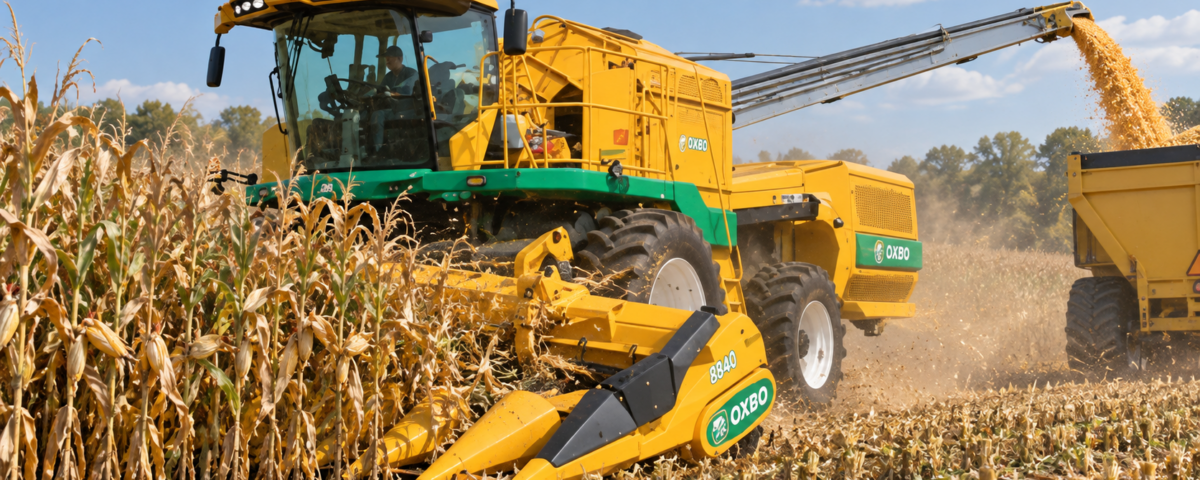
If you operate an Oxbo harvester, sprayer, application machine, or other specialty agricultural equipment, you know that downtime during a short harvest or application window can be extremely expensive.
Modern diesel engines have become cleaner and more sophisticated, but that sophistication has also added considerably more equipment to the engine and exhaust system. Components such as DEF, SCR, DPF, DOC, EGR valves, EGR coolers, NOx sensors, temperature sensors, differential-pressure sensors, dosing systems, and aftertreatment control modules all have to operate correctly for the machine to perform as designed.
At TM AG Tuning, we work with diesel-powered agricultural and heavy equipment to diagnose engine and emissions-related problems and provide custom tuning solutions for supported applications.
We recently completed work on an Oxbo 8840 corn harvester, making this a good opportunity to explain how modern Oxbo emissions systems work, why operators experience problems with them, and why some owners investigate DEF, DPF and EGR removal or emissions tuning for applications where modification is legally permitted.
Oxbo currently produces an extensive range of specialty agricultural equipment for seed corn, sweet corn, application, beans and spinach, berries, coffee, forage, grapes and olives, peas, pistachios, potatoes, and tomatoes. The Oxbo 8840 itself is a high-capacity seed and sweet corn harvester that Oxbo specifies with a 550 HP Scania diesel engine.
Because engines and emissions configurations vary by model, year, engine manufacturer and market, not every Oxbo machine uses the exact same aftertreatment system.
What Is a DEF System on an Oxbo?
DEF stands for Diesel Exhaust Fluid.
DEF is not actually injected into the engine. It is stored in a separate tank and injected into the exhaust as part of the machine’s Selective Catalytic Reduction system, commonly called SCR.
Diesel Exhaust Fluid is a urea-based solution. When it is introduced into the hot exhaust stream, it ultimately allows the SCR catalyst to convert nitrogen oxides, or NOx, into primarily nitrogen and water.
In simple terms, the DEF/SCR system exists to reduce NOx emissions coming out of the exhaust.
Cummins describes modern aftertreatment systems as using DEF in the exhaust stream ahead of the SCR catalyst, where the SCR system converts NOx into nitrogen and water.
A modern DEF/SCR system can involve substantially more than the DEF tank itself. Depending on the engine and machine, the system may include a DEF tank, heater, pump or supply module, DEF injector/doser, DEF lines, quality or concentration sensing, NOx sensors, exhaust temperature sensors, SCR catalyst and a separate aftertreatment controller.
That means a warning on the display saying DEF fault does not necessarily mean there is anything wrong with the fluid in the tank.
The problem could be somewhere else in the SCR system.
Common DEF and SCR Problems
DEF systems operate in a difficult environment. Agricultural equipment can spend long days working in dust, heat, mud and crop residue, followed by extended periods sitting between seasons.
Eventually, operators can encounter faults involving DEF pressure, DEF quality, tank heaters, dosing injectors, pumps, NOx sensors, wiring or the SCR catalyst itself.
The most frustrating part is that the engine may still mechanically run perfectly.
However, because the engine controller and aftertreatment controller continuously monitor emissions performance, an SCR-related fault can trigger warning lights, diagnostic codes and, on some systems, an eventual engine power or speed derate.
That can turn what appears to be a relatively minor sensor or aftertreatment problem into a machine that cannot operate normally during harvest.
What Is a DPF?
DPF stands for Diesel Particulate Filter.
Unlike DEF/SCR, which primarily targets nitrogen oxide emissions, a DPF is designed to physically capture particulate matter produced by diesel combustion.
In everyday terminology, that particulate matter is usually called soot.
The exhaust travels through the DPF, where soot is trapped instead of being released directly through the exhaust.
Eventually the filter has to clean itself.
That process is called regeneration, or simply a regen.
During regeneration, exhaust temperature is increased sufficiently to oxidize accumulated soot. Although much of the soot can be burned during regeneration, noncombustible ash gradually remains in the filter and can eventually require physical DPF cleaning or replacement.
EPA technical information describes DPFs as filters that trap particulate matter from diesel exhaust and notes that the accumulated material must be periodically burned or otherwise removed.
Why Does an Oxbo Need to Regenerate?
A DPF has a finite soot capacity.
Engine software therefore monitors the filter using information such as exhaust temperature, operating conditions, differential pressure and calculated soot loading.
When the calculated or measured loading reaches certain thresholds, the engine can request a regeneration event.
For equipment that operates at sustained engine load and exhaust temperature, regeneration may happen with relatively little operator involvement.
Problems are more likely when the machine cannot achieve the required exhaust conditions, a sensor provides incorrect information, a regeneration is repeatedly interrupted, the engine is producing excessive soot, or the DPF has accumulated excessive ash.
Eventually, the operator may see warnings such as DPF full, regeneration required, exhaust system fault, high soot load, or related engine and aftertreatment diagnostic trouble codes.
In severe cases, the machine can derate.
What Is EGR?
EGR stands for Exhaust Gas Recirculation.
EGR works differently from both DEF and DPF.
Instead of treating emissions farther down the exhaust, the EGR system redirects a controlled quantity of exhaust gas back into the engine’s intake.
Doing this reduces combustion temperatures under certain operating conditions and helps reduce the formation of nitrogen oxides.
A typical heavy-duty diesel EGR system can contain an EGR valve, EGR cooler, piping and associated pressure, temperature or position sensors.
The disadvantage is that exhaust gas containing combustion byproducts is being routed back through portions of the intake system.
Over thousands of operating hours, soot mixed with oil vapour can contribute to contamination and deposits in EGR and intake components.
EGR valves and EGR coolers also introduce additional mechanical components that can eventually become restricted, stick, leak or fail.
DEF vs. DPF vs. EGR — What Is the Difference?
Although people often refer to everything collectively as an “emissions system,” the three systems have different jobs.
EGR operates primarily on the engine side by recirculating a controlled amount of exhaust back through the engine to reduce NOx formation.
DPF operates in the exhaust and traps diesel particulate matter or soot.
DEF/SCR operates farther downstream in the exhaust and uses Diesel Exhaust Fluid and an SCR catalyst to reduce NOx emissions.
Many modern diesel engines use several of these technologies together.
That is why diagnosing an emissions-related problem correctly is important. Replacing a DPF will not repair a failed DEF pump, and replacing a NOx sensor will not correct an EGR valve that is sticking.
Why Do Some Oxbo Owners Consider DEF, DPF and EGR Removal?
The biggest reason is usually reliability and downtime, rather than simply horsepower.
Specialty harvesting equipment is unlike a machine that can easily sit for several days waiting for a repair.
Sweet corn, seed corn, vegetables, fruit and other specialty crops have very specific harvest windows. When the crop is ready, the machine needs to operate.
An emissions-related derate during that window can become extremely expensive.
Where emissions modifications are permitted for the machine’s intended use, owners may investigate removing or disabling certain emissions functions to simplify the machine and reduce dependence on aftertreatment components.
Potential reasons operators seek this type of modification include reduced exposure to DEF/SCR component failures, elimination of DEF consumption when the SCR system is lawfully removed, elimination of DPF regeneration interruptions when the DPF system is lawfully removed, reduced dependence on exhaust sensors and dosing equipment, less EGR-related intake contamination, and reduced risk of an emissions fault putting the machine into a power derate.
These benefits depend heavily on the specific engine and application. An emissions modification should not be treated as a substitute for diagnosing an unrelated engine, fuel, turbocharger, electrical or mechanical problem.
Benefit of Removing the DPF
One of the main reasons an owner may consider DPF removal in an eligible application is to eliminate the maintenance cycle associated with trapping soot.
Without an active DPF system, the machine no longer needs to manage DPF soot loading or perform DPF regeneration.
That means there is no DPF to eventually plug with soot or ash, no DPF differential-pressure fault caused by the filter itself, and no harvest interruption caused specifically by a failed regeneration process.
Removing a restrictive or heavily loaded DPF can also reduce exhaust backpressure.
Benefit of Removing DEF/SCR
For a lawful application in which the complete SCR strategy is removed correctly, the machine no longer depends on DEF dosing in order to operate.
That can eliminate DEF consumption and potential problems associated with DEF pumps, dosing injectors, DEF quality faults and portions of the NOx-monitoring system.
For an operator working far from a dealership, the reduction in system complexity can be particularly attractive.
A $50 sensor isn’t necessarily the expensive part of a breakdown.
The expensive part may be losing hours or days of production while the machine is derated.
Benefit of Removing EGR
The primary operational attraction of an EGR delete is eliminating exhaust-gas recirculation through the engine’s intake system.
Depending on engine design, this can reduce soot contamination within the EGR and intake circuits and remove failure points associated with the EGR valve and EGR cooler.
EGR coolers can leak, EGR valves can stick and carbon deposits can accumulate over time.
A properly calibrated EGR-off strategy for an eligible application must account for how the engine was originally designed to operate. Simply blocking an EGR pipe without correctly addressing the engine controls is not the same thing as a professional calibration.
Can Emissions Removal Increase Horsepower?
Emissions removal and performance tuning are two separate things.
An emissions calibration can be designed to maintain approximately factory power.
Alternatively, where appropriate for the engine, transmission, driveline and application, a separate performance calibration may be possible.
Owners should be cautious of the idea that simply deleting a DPF, DEF system or EGR automatically creates a huge horsepower gain. The engine’s fuel quantity, boost targets, torque limits, rail-pressure strategy, smoke limitation, thermal protection and numerous other maps influence power output.
At TM AG Tuning, our goal is to develop a calibration around the machine and its intended use rather than simply chasing a maximum horsepower number.
For agricultural equipment, usable torque, drivability and reliability are usually considerably more valuable than an impressive peak horsepower figure.
Does an Oxbo Delete Improve Fuel Economy?
You will see better Fuel consumption.
Removing repeated active regeneration events can eliminate the additional fuel associated with those DPF regeneration. A machine with a badly restricted DPF or malfunctioning EGR system may also be operating inefficiently before repairs or modification.
Oxbo 8840 DEF, DPF & EGR Tuning
The Oxbo 8840 is one of Oxbo’s high-capacity corn harvesters and is designed for sweet corn and seed corn applications.
Oxbo lists the 8840 with a 550 horsepower Scania engine, a 65-inch feeder house, its IntelliClean two-stage cleaning system and compatibility with Oxbo 60 Series folding corn heads.
We recently completed an Oxbo 8840 for a customer, adding another specialty agricultural application to the equipment we work with at TM AG Tuning.
Machines like the 8840 are exactly where reliability matters.
When a large corn harvester is working through a narrow harvest window, an aftertreatment-related derate is much more than an annoying warning light. It can affect trucks, employees, field logistics, processing schedules and the entire harvest operation.
If you have an Oxbo 8840 with an engine or emissions-related issue, contact us with the machine model, model year, engine information, serial number and any active diagnostic trouble codes. From there, we can determine what support options are available for that particular configuration.
Other Oxbo Equipment
Oxbo’s equipment range extends far beyond the 8840.
The company’s current product catalog includes application equipment and specialized machines for beans and spinach, berries, coffee, forage, grapes and olives, peas, pistachios, potatoes, seed corn, sweet corn and tomatoes. Current models include equipment such as the Oxbo 9840, 8840, 8530, 8520, 2580 and 2560 corn harvesters; AT Series application equipment; 7650 and 7550 applicators; 6430, 6030 and 6230 grape equipment; GP6300 pea harvester; BH8150 and GB7150 bean equipment; and numerous other specialty machines.
Engine and emissions configurations can differ substantially between these machines.
For that reason, we do not recommend assuming that a tuning solution available for one Oxbo model automatically applies to another.
Send TM AG Tuning the machine details and we can identify the engine and electronic control system before determining available options.
Oxbo Emissions Faults and Derates
You do not necessarily need to know whether the problem is DEF, DPF, SCR or EGR before contacting us.
If your Oxbo is displaying a warning, has reduced power or is showing engine or aftertreatment fault codes, send us the codes.
Common symptoms of aftertreatment problems can include an engine derate, reduced RPM, DEF warning, DPF warning, regeneration request, regeneration that will not complete, excessive soot-load indication, NOx sensor codes, DEF dosing faults, EGR-related codes, exhaust temperature-sensor faults, SCR efficiency faults, repeated check-engine lights, or a machine that returns to derate shortly after faults are cleared.
The diagnostic codes and engine information are often the fastest starting point.
Why Professional Calibration Matters
Modern diesel engine controllers are much more sophisticated than simply having an “EGR switch” or “DPF switch.”
The engine ECU may calculate soot loading, monitor differential pressure, evaluate exhaust temperatures, command regeneration, communicate with a separate aftertreatment controller, monitor DEF dosing and NOx conversion, calculate engine torque and communicate with multiple other controllers across the machine.
A poorly developed calibration can therefore result in warning lights, incorrect torque output, diagnostic problems, communication faults, poor drivability or future service complications.
Proper tuning requires understanding the engine-management strategy and making changes appropriate to that particular ECU software version.
This is especially important with specialty equipment because the engine controller is only one part of a larger machine.
Oxbo Tuning and Remote Support
TM AG Tuning works with agricultural, construction, forestry and heavy equipment applications.
Depending on the specific Oxbo engine and controller, support may involve a remote connection, diagnostic equipment, reading the ECU through an appropriate service interface, or removing and reading an ECU on the bench.
The exact process depends on the engine and electronic control system installed in the machine.
If you are unsure what ECU your Oxbo uses, you do not need to identify it yourself.
Send us photos of the machine information, engine tag and ECU label along with the model and serial number.
Our team can determine what is required from there.
Need Help With an Oxbo 8840 or Other Oxbo Equipment?
If your Oxbo 8840 is experiencing DEF, DPF, EGR, SCR or engine-related problems—or you want to find out what tuning options are available for another Oxbo machine—contact TM AG Tuning.
Send us:
Oxbo model and year, machine serial number, engine make and model, ECU information if available, photos of the engine and ECU tags, and any active fault codes showing on the machine.
We can use that information to determine the engine-management system and what options are available.
Whether you are dealing with an Oxbo 8840 DEF fault, Oxbo DPF problem, Oxbo EGR issue, Oxbo engine derate, Oxbo SCR fault or Oxbo ECU tuning question, TM AG Tuning can help determine the next step.
TM AG Tuning
Agricultural & Heavy Equipment ECU Tuning
Remote and bench tuning solutions for supported agricultural, construction, forestry and heavy equipment applications.
Contact TM AG Tuning today with your Oxbo model, engine information and fault codes to find out what options are available.